

As we move through the week, an interesting dynamic is taking place. On the surface, stocks look good. Indices are performing well, and European stocks are higher today. Global bond yields are falling as the oil price continues its retreat as the direct conflict between Iran and the US remains on pause. The Brent crude oil price has fallen another 2% on Tuesday and is trading below $84 per barrel and is down 12% in the past week.
Source of market risk shifting as we move through Q3
Falling commodity prices combined with lower bond yields should be good news for stocks, however, the driver of market risk has shifted from geopolitics to concerns about the AI trade. Underneath the surface, one of the biggest themes for global markets is struggling.
Chinese competition and financing fears lead to chip maker sell off
The AI trade is in focus as chip stocks have sold off sharply this week, and the Kospi index in South Korea, which has the highest exposure to domestic chip makers, slumped 10.8% today, triggering a circuit breaker that closed the index at one point. SK Hynix and Samsung both fell nearly 15%. The triggers for the decline are two-fold. Firstly, there are growing concerns about the financing of the AI build out and secondly fears about growing competition from China.
Momentum in the AI trade is shifting. Although the Nasdaq posted a mild loss on Monday, the world’s most valuable company, Nvidia, fell nearly 5%, and is continuing to decline in the pre-market on Tuesday, where it is down a further 1%. The sell-off in Nvidia and the chip space more generally, came after reports that Nvidia will provide $250bn in financing guarantees for the 10 gigawatt OpenAI data centre in Ohio. This would help the developers to secure construction financing for what is expected to be the world’s largest data centre. Reports also suggest that Nvidia could provide another $350bn for chip purchases. The data centre is expected to take 2 years to build. This news highlights two issues for investors right now: 1, the amount of money involved to secure AI infrastructure is getting larger and larger, leading to bubble fears, 2, investors are running out of patience to see these investments pay off.
China becomes major threat to US AI dominance
Chinese competition is another key driver of volatility in the AI trade in recent weeks. ASML’s share price is down 1.6% on Tuesday, but it is lower by 11% in the past 5 days. It is facing a direct threat from China after Beijing announced that it was developing its own deep ultraviolet lithography machine that is used to create semiconductor chips. This will break ASML’s monopoly of this technology, and has spooked investors and the European tech sector, which has ASML at its centre.
CXMT debut provides hope that AI build-out inflation could be at its peak
Added to this, the stellar stock market debut of Chinese chip maker, CXMT is a sign that China is now a major player in the chip-making space, and it threatens US dominance of AI. While this is shaking up the AI trade today, in the future more competition is a good thing and could bring down the cost of the AI infrastructure build out. Of course, Chinese AI dominance could come under the radar of US tariffs, however, Apple has requested that CXMT is not included on the US trade blacklist, which suggests that Apple is willing to expand its usage of Chinese chips.
Overall, the recent volatility in the chip trade suggests that the AI theme is shifting as we move through Q3, after a strong performance in Q2. For example, although ASML is down 11% in the past week, it is still higher by 52% this year, likewise, South Korea’s Kospi is also higher by 42% YTD, and is still the best performing major equity index this year.
Looking ahead, chip stocks in the US are likely to remain under pressure, even if stock market losses are milder today compared to Monday. Added to this, investors are waiting for some key event risk in the coming days. Apple, Meta, Microsoft and Amazon all report results this week. The focus will be on their AI expenditure, and their profitability levels. The market is not in the mood for disappointment, so the mega-cap US hyperscalers will have to post performances that are well above already high expectations to ease fears about the AI trade, in our view.
LVMH fails to impress
Earnings in Europe are also worth noting. LVMH reported its first quarter of growth in its fashion and leather goods division for 2 years, however, its share price is down 0.9% today after the 1% growth rate in sales fell below expectations for a 1.7% increase. Sales growth overall was decent, with sales of watches higher by 11%, driven by flush US consumers. However, these results are unlikely to shift the dial for LVMH’s stocks price. It is lower by 27% this year, and it is a laggard in the space, as its rivals have posted stronger results and a stronger stock market performance this year.
Although LVMH is slipping today, Hermes and Kerring are higher by 1% and 2% respectively, suggesting that the market does not see LVMH’s woes as signs of concern for the broader luxury sector, instead it is an internal problem. While some consumers are favouring its central brand, Louis Vuitton, not enough are, as it loses its sparkle with both US and Asian shoppers.
Overall, price action in Europe is benign on Tuesday morning, but all eyes will be on the tech sector in the US, when it opens later today. There are signs of stress in the AI trade, including in the CDS market of some AI hyperscalers and chip makers. For now, this is not noticeable at the index level, with indices in Europe rising this morning and US futures pointing to a mild loss for the S&P 500 later on Tuesday, and a 0.7% decline for the Nasdaq.
The broader market will be more impacted by Wednesday’s FOMC meeting, there is currently a 33% chance of a hike at tomorrow’s meeting.
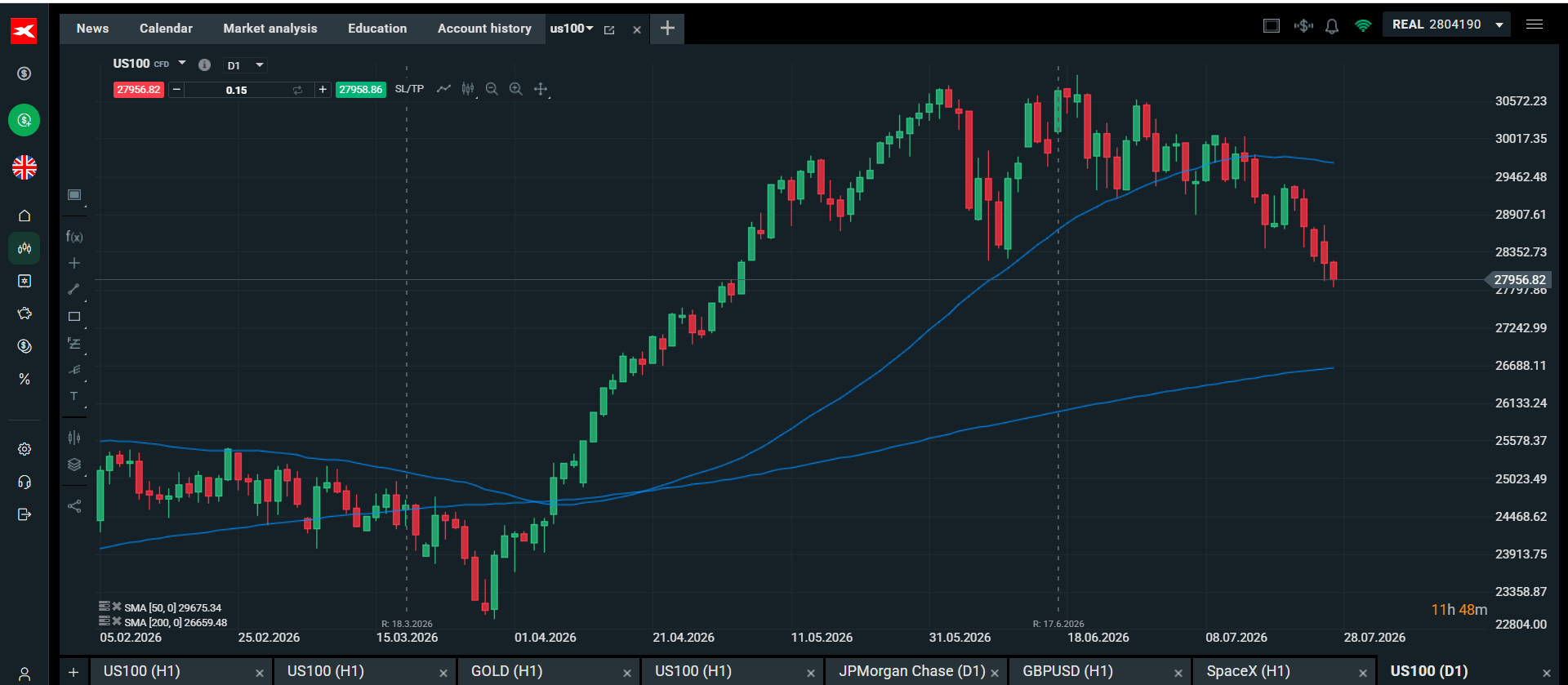
Chart 1: Nasdaq 100 below its 50-day sma, suggesting momentum remains to the downside
Source: XTB

Live Market Update: UK Economy & Fed


ASML sell-out: Dreams and rumors will not break the monopoly



Chart of the Day: Who suffers from the oil price drop? (28.07.2026)



Economic Calendar: PayPal, Visa and Coca-Cola to overshadow macro data (28.07.2026)
This content has been created by XTB S.A. This service is provided by XTB S.A., with its registered office in Warsaw, at Prosta 67, 00-838 Warsaw, Poland, entered in the register of entrepreneurs of the National Court Register (Krajowy Rejestr Sądowy) conducted by District Court for the Capital City of Warsaw, XII Commercial Division of the National Court Register under KRS number 0000217580, REGON number 015803782 and Tax Identification Number (NIP) 527-24-43-955, with the fully paid up share capital in the amount of PLN 5.869.181,75. XTB S.A. conducts brokerage activities on the basis of the license granted by Polish Securities and Exchange Commission on 8th November 2005 No. DDM-M-4021-57-1/2005 and is supervised by Polish Supervision Authority.
