

The market has long been wondering whether it is worth continuing to bet on the largest companies involved in development in the field of artificial intelligence. Meta was one of the leaders in AI adoption, on which it had been earning real money for many quarters. Before today's publication, investors expected stellar results, hoping for proof that the murderous pace of spending on artificial intelligence would translate into hard monetization to an even greater extent. Instead, Mark Zuckerberg served the market a textbook cold shower: it doesn't matter that the advertising machine generates a river of cash, since profits were eaten up by billions in reserves for legal disputes, severance pay for laid-off employees, and an insatiable appetite for new servers. Initially, a drop of 5% was observed, while a few minutes later in post-session trading, the declines deepened to 9%, leading to even greater drops on the technological Nasdaq, despite earlier strong attempts at a rebound.
Q2 Results: Advertising masters failed to beat profit expectations
At the revenue level alone, Meta showed form that the rest of the industry envies, not only those operating in advertising but also in the AI industry. Unfortunately, the more closely we look at the results, the worse the comparison looks for the company:
- Total revenue: 60.80 billion USD (+28% y/y) vs expected 60.24 billion USD. We observe a small beat of the consensus here. This is too little to stimulate market expectations.
- Advertising revenue: 59.36 billion USD (+27% y/y) vs consensus of 59.07 billion USD.
- Family of Apps segment (revenue): 60.37 billion USD (+28% y/y) with estimates at 59.77 billion USD.
- Operating profit: 18.78 billion USD (down 8.2% y/y), which is a painful disappointment against the expected 21.50 billion USD.
- Operating profit of the advertising segment (Family of Apps): 23.39 billion USD (-6.3% y/y) compared to 26.11 billion USD expected by the market.
- Operating margin: 31%. This is a significant drop compared to the result from a year ago, when the margin was a powerful 43%, and the market expected a safe 35.6%.
- Earnings per share (EPS): 6.18 USD compared with 7.14 USD a year earlier and analyst expectations reaching 7.15–7.22 USD.
- Ad metrics and users: Ad impressions increased by 14% y/y (expected +14.6%), average price per ad jumped by 12% y/y (expected +11.7%), and daily active people (DAP) reached 3.60 billion (expected 3.61 billion).
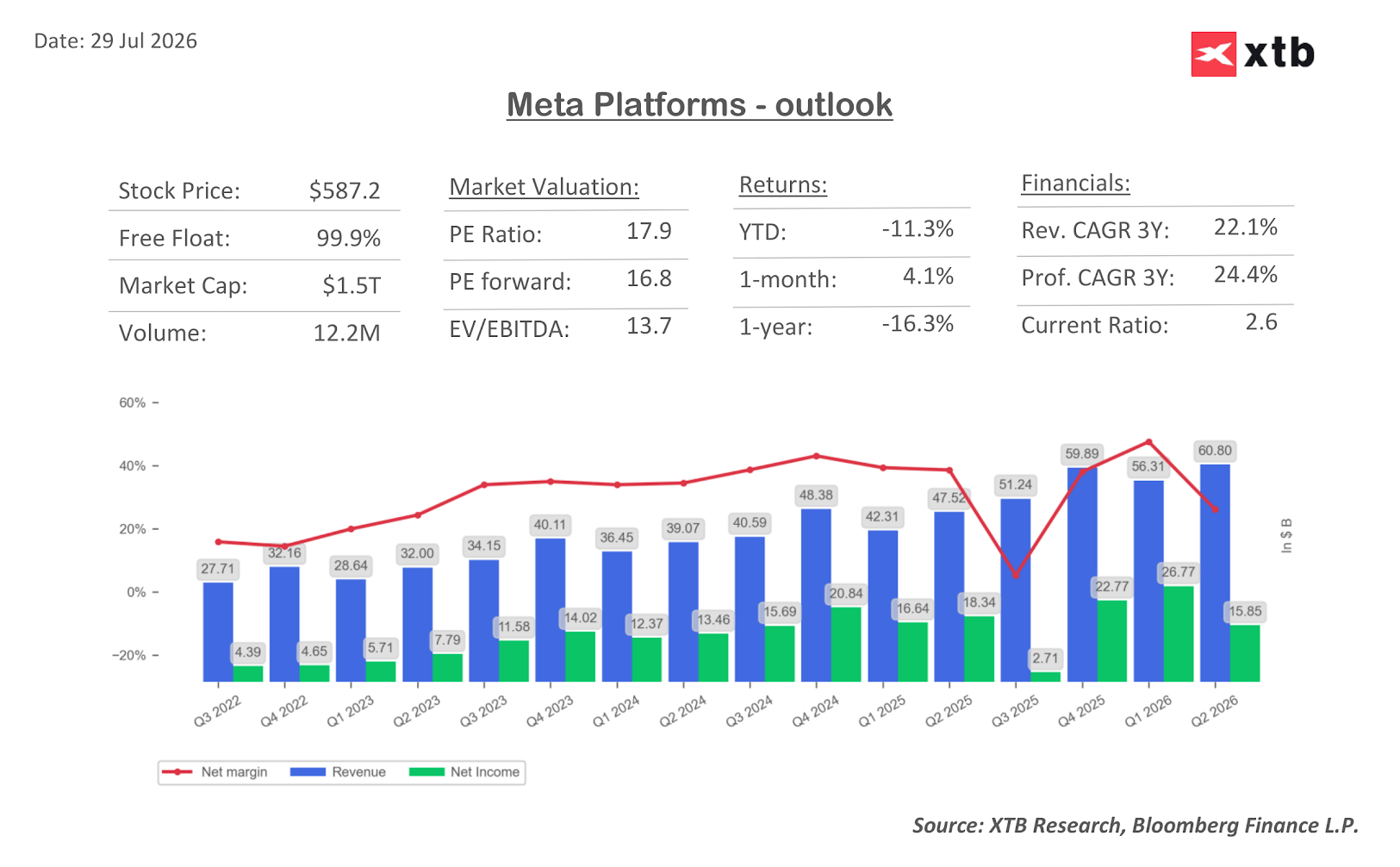 Outside of Q3 2025, we have the lowest profit since Q3 2024. Source: Bloomberg Finance LP, XTB
Where did the money go? Lawyers, severance pay, and more cash sunk in the metaverse
Investors might rub their eyes in amazement looking at the gap in profits. We haven't seen such a large disappointment in EPS in a Big Tech company in a long time. Usually, even a small beat of expectations was enough to lead to a strong sell-off, and today we have a major disappointment, although it should still be emphasized that these are relatively good results. The answer to the question of where the profits went lies in a basket of one-off and disreputable expenses that harmed profitability in the second quarter:
- 2.40 billion USD for legal disputes: Meta was hit with a massive legal fee related to ongoing proceedings. Worse, the company warned that upcoming trials in the US regarding the platforms' impact on youth could bring further "material losses".
- 1.18 billion USD for severance pay: This is the cost of May's mass layoffs. Headcount at the end of June fell by 1% y/y to 75,472 people.
- Reality Labs continues to burn billions: The segment responsible for the metaverse and virtual reality recorded a 4.62 billion USD operating loss (compared to a 4.53 billion USD loss a year ago and expected -4.45 billion USD), generating only 431 million USD in revenue.
Forecasts for Q3 and the full year: Even higher CAPEX and withered estimates
If the disappointing profit in Q2 were the only problem, the market might forgive this glitch. However, announcements for the coming months only added fuel to the fire:
- Q3 revenue below expectations: Meta estimates third-quarter sales in the range of 61–64 billion USD. The midpoint of this forecast (62.5 billion USD) clearly misses the market consensus set at 63.17 billion USD.
- Raising the lower bound of CapEx: The company does not intend to save on AI infrastructure. Full-year capital expenditures have been narrowed to 130–145 billion USD (previously the lower bound was 125 billion USD), exceeding average analyst forecasts (135.8 billion USD).
- Higher total costs: Full-year operating expenses will rise to 165–169 billion USD (instead of the planned 162–169 billion USD).
- Higher tax rate: The company raised its forecast for the effective tax rate for the second half of the year to 15–17% (from 13–16%).
Zuckerberg's Vision: From Texas to an open-source vision
Despite the company's shares and the broad market flashing red, Mark Zuckerberg continues to build his grand narrative. Meta's CEO claims that artificial intelligence not only drives ads but "opens the door to completely new business opportunities for enterprises":
- Giant project with BlackRock: Parallel to the results, plans were revealed to build a data center campus in El Paso, Texas, worth 14 billion USD in cooperation with BlackRock.
- Political-technological manifesto: Zuckerberg loudly opposes ideas for banning Chinese AI models or imposing export restrictions on chips. He promotes a vision of open-source software as a tool meant to put power in the hands of individuals, not closed corporations.
- Announcement of full-year profit improvement: Despite pressure on margins, management maintains that full-year operating profit for 2026 will be higher than in 2025.
A cold shower
Meta remains an incredibly efficient machine for making money on digital ads. The problem is that investors no longer want to pay for "promises and potential" at the level of artificial intelligence while net profit is being depleted by legal and restructuring costs. Until billions in server investments start bringing direct, separate business revenues (e.g., from an AI Cloud line), the market will treat every CapEx increase as an unnecessary burden.
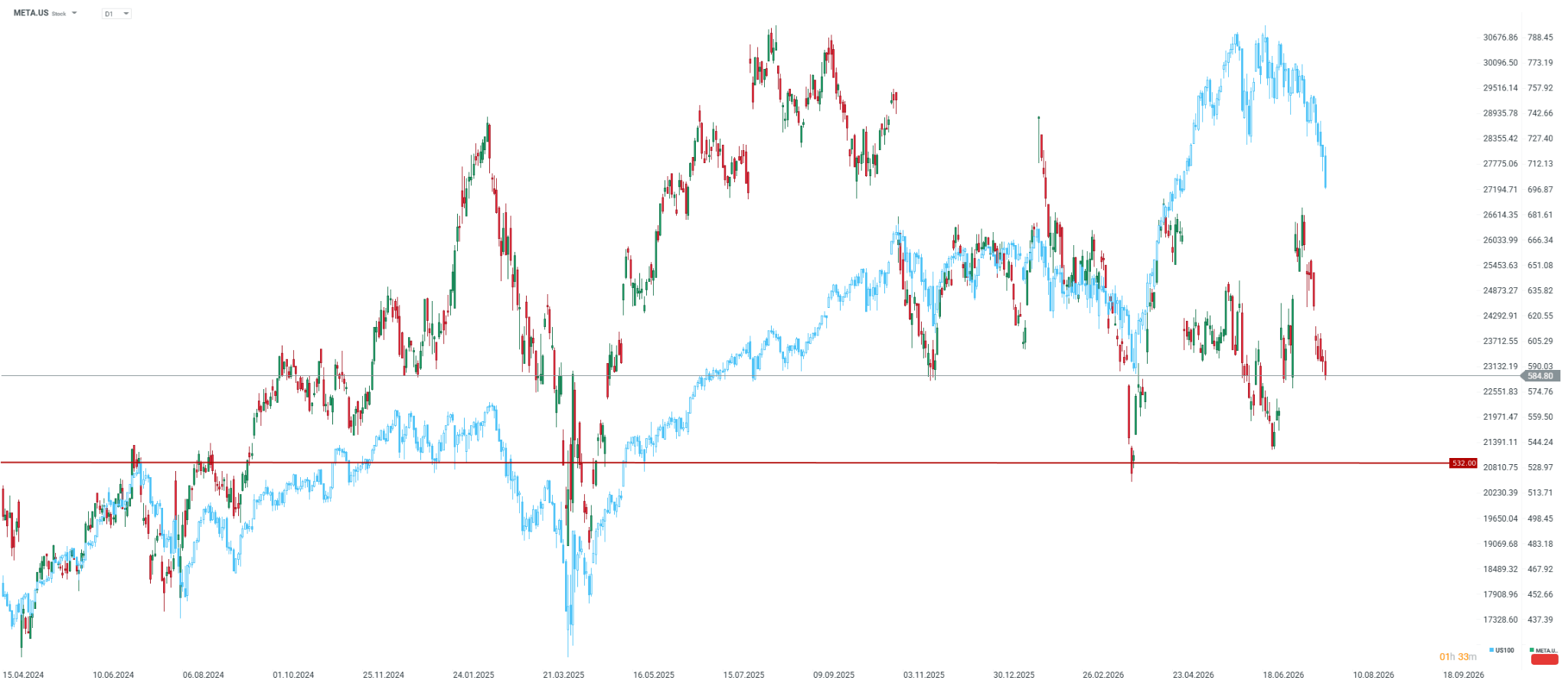 Meta shares could open around 532 USD, which would give the lowest levels since March 31. Due to the strong pull-back of Meta and market concerns about the Fed's decision and Trump's plans regarding Iran, US100 is deepening its declines and hitting its lowest level since April 30. Source: xStation5



Chalk and Cheese: Meta and Microsoft earnings round up

Microsoft shows how to make money on data centers. AI investments are starting to pay off


The FOMC Review
Meta Preview: Will Advertising Fund Its AI Ambitions?
This content has been created by XTB S.A. This service is provided by XTB S.A., with its registered office in Warsaw, at Prosta 67, 00-838 Warsaw, Poland, entered in the register of entrepreneurs of the National Court Register (Krajowy Rejestr Sądowy) conducted by District Court for the Capital City of Warsaw, XII Commercial Division of the National Court Register under KRS number 0000217580, REGON number 015803782 and Tax Identification Number (NIP) 527-24-43-955, with the fully paid up share capital in the amount of PLN 5.869.181,75. XTB S.A. conducts brokerage activities on the basis of the license granted by Polish Securities and Exchange Commission on 8th November 2005 No. DDM-M-4021-57-1/2005 and is supervised by Polish Supervision Authority.
